

Epistaxis Relief: How We Treat Severe Nosebleeds in Portland, OR
Enduring severe nosebleeds can be frightening and disruptive, requiring swift medical intervention to safely stop the bleeding and prevent complications. Columbia Clinic Urgent Care utilizes advanced treatments, such as targeted cauterization and specialized nasal packing, to directly address the source of your epistaxis. If you are struggling to control a heavy nosebleed, trust our dedicated healthcare professionals in Portland, OR, to provide the fast, reliable relief you need. For more information, please contact us or book an appointment online. We have convenient locations to serve you in Portland at 82nd Avenue Portland OR and Mall 205 Portland OR.
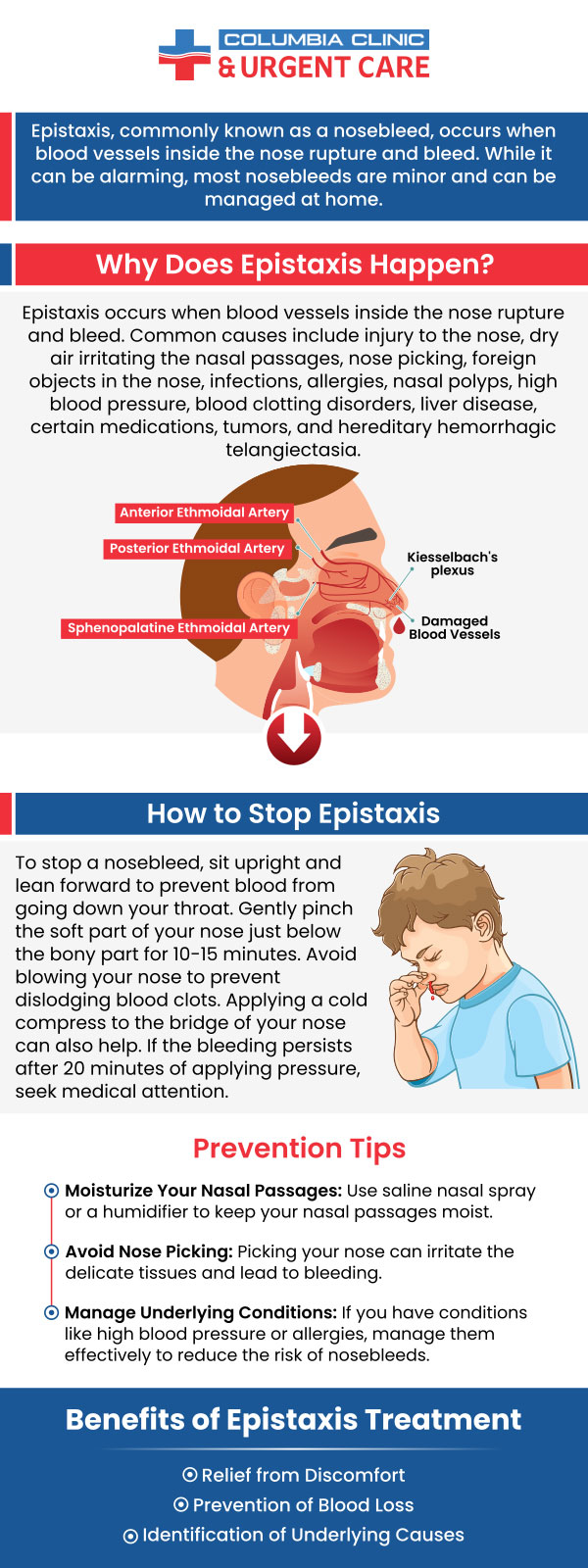
Table of Contents:
What is nasal packing, and when is it necessary for severe epistaxis?
What is the difference between treating an anterior and a posterior nosebleed?
What are the restrictions or aftercare steps following a professional nosebleed treatment?
Does Columbia Clinic in Portland offer same-day appointments for patients experiencing highly active, severe nosebleeds?
Nasal packing is a treatment used to control a significant nosebleed, also called epistaxis. A clinician places material inside the nose to apply steady pressure to bleeding vessels. This may include an absorbable dressing, a specially designed sponge, or an inflatable balloon. Absorbable packing gradually dissolves; other types must be removed by a healthcare professional.
A clinician may recommend packing when bleeding continues despite firm pressure, medication applied inside the nose to narrow blood vessels, or cauterization—a procedure that seals a visible bleeding vessel. Packing may also be needed when bleeding is too heavy to identify its source.
During a nosebleed evaluation, tell your clinician how long the bleeding has lasted, whether you have had an injury, and whether you take blood-thinning medication or have a bleeding disorder. These details help determine the safest treatment and whether a higher level of care is necessary.
Most nosebleeds begin near the front of the nose and may be treated with anterior packing. Bleeding farther back, called posterior epistaxis, can be harder to control and may cause blood to flow heavily down the throat. It can require emergency department treatment, an ear, nose, and throat specialist, and hospital monitoring. Bleeding that continues despite packing may require additional procedures.
Packing can cause pressure, discomfort, and temporary difficulty breathing through the nose. Possible complications include rebleeding, irritation or injury to the nasal lining, and infection; serious complications are uncommon.
If packing is placed, follow the treating clinician’s aftercare instructions. Nonabsorbable packing is often removed within a few days, depending on its type and the source of bleeding. Antibiotics are not always necessary; the clinician will decide based on your circumstances.
For an active nosebleed:
● Sit upright and lean forward.
● Pinch the soft part of your nose continuously for 15–20 minutes without releasing pressure to check.
● Do not tilt your head back or push tissues deep into your nose.
The main difference between anterior and posterior nosebleeds is where the bleeding starts and how difficult it is to control. Anterior nosebleeds begin near the front of the nasal septum and often respond to simple first aid. Posterior nosebleeds start deeper in the nose, can cause heavier bleeding, and usually require emergency hospital treatment.
Treating an anterior nosebleed
Sit upright, lean forward, and firmly pinch the soft part of your nose, closing both nostrils. Hold steady pressure for 15–20 minutes without releasing it to check. Breathe through your mouth and spit out blood rather than swallowing it.
For recurrent or otherwise concerning nosebleeds that are not severe and have stopped, an evaluation at Columbia Clinic Urgent Care can help identify possible contributing factors and guide next steps. Depending on the findings and available services, treatment may include medication to constrict blood vessels, cautery to seal a visible bleeding point, or nasal packing. Most uncomplicated anterior nosebleeds do not require hospitalization.
Treating a posterior nosebleed
Posterior nosebleeds are harder to reach and may cause heavy bleeding into the throat or bleeding from both nostrils. However, these signs alone cannot confirm where the bleeding originates.
A suspected posterior nosebleed should be evaluated in an emergency department rather than an urgent care clinic. Treatment focuses first on protecting the airway and assessing blood loss. An emergency clinician or ear, nose, and throat specialist may use an endoscope to locate the source and place a specialized balloon or posterior nasal pack.
Posterior packing generally requires hospital admission and monitoring because bleeding can recur and the packing can affect breathing. Persistent bleeding may require surgery or embolization, a procedure that blocks the bleeding vessel through a catheter. Significant blood loss may also require intravenous fluids or a transfusion.
Proper aftercare can help your nose heal and reduce the chance of another nosebleed. Your instructions will depend on how the bleeding was treated, such as with cautery or nasal packing. Follow the discharge instructions provided by your treating clinician, including any recommendations for specialist care.
Protect the inside of your nose
Avoid blowing or picking your nose, rubbing it forcefully, or inserting tissues or cotton swabs. These actions can dislodge a clot or disturb a treated area. Restrictions may last several days or, after cautery, one to two weeks, depending on your clinician’s instructions.
Take it easy during recovery
For at least the first 24–48 hours, avoid strenuous exercise, heavy lifting, bending forward, and straining during bowel movements. Your clinician may recommend longer restrictions.
Use nasal treatments as directed
Your clinician may recommend saline spray, saline gel, or an ointment to reduce dryness and support healing. A humidifier may also help.
If you have nasal packing:
● Ask your clinician before using nasal sprays or ointments.
● Do not pull out, trim, or adjust the packing yourself.
● Follow instructions for removal. Some packing dissolves, while other types require a scheduled appointment.
Keep your follow-up appointment
Attend any recommended follow-up visit with Columbia Clinic Urgent Care or the specialist listed in your discharge instructions. Packing removal and reassessment are important even if bleeding has stopped.
Contact your treating clinician promptly if you develop fever, increasing pain, foul-smelling drainage, or facial swelling. If you undergo surgery or embolization, follow the procedure-specific aftercare instructions from your specialist.
Contact your nearest Columbia Clinic Urgent Care location to confirm same-day availability and whether the clinic can evaluate your nosebleed. Do not wait for an appointment if bleeding is heavy or ongoing—a severe nosebleed may require an emergency department rather than urgent care.
While getting help, sit upright, lean forward, and firmly pinch the soft part of your nose for 15–20 minutes without releasing pressure. Breathe through your mouth and spit out blood instead of swallowing it.
Call 911 if bleeding is profuse, you have trouble breathing, or you feel faint, weak, or confused. Seek emergency care if bleeding continues after 15–20 minutes of uninterrupted pressure, follows a significant injury, or is heavy while you take blood-thinning medication.
For more information, please contact us or book an appointment online. We have convenient locations to serve you in Portland at 82nd Avenue Portland OR and Mall 205 Portland OR. We serve patients from Tibbetts St Portland, Milwaukie OR, Oak Grove OR, Stark Street Portland, Fairview OR, Happy Valley OR, Gladstone OR, Cedar Mill OR, Tibbetts Street Portland OR, West Linn OR, Oregon City OR, and surrounding areas.
Check Out Our 5 Star Reviews






 Send Text
 How May I Help You?
